
Europe
Europe

Browse country pages in this region:
Do you need help?
Find information and helpful services for refugees, asylum-seekers and stateless persons, read more about your rights and duties, and view the frequently asked questions on the Help page:
See the Help page
Are you looking for a way to study at university?
Find accredited higher education academic or scholarship programmes verified by UNHCR on the Scholarship Opportunities for Refugees platform.
Europe has a long history of offering sanctuary to refugees. The 1951 Refugee Convention was established as a response to the urgent needs of refugees generated by World War II. Since then, Europe has received people seeking asylum as they flee conflict, persecution and human rights violations.
Refugee numbers in the Europe region fluctuate, increasing at times of upheaval and settling back as solutions are found for them. Authorities and communities are making efforts to welcome refugees, with our support. Apart from refugees, the mandate of UNHCR also includes asylum-seekers, stateless people and internally displaced persons.
As of 31 December 2021, UNHCR was serving 12.1 million people in Europe, roughly 81,000 more than by the end of 2020. The number of people UNHCR serves globally by the end of 2021 was 94.7 million.
With a Regional Bureau in Geneva, Switzerland, and office presence in 36 European countries, we are able to operate in 49 States and one territory in the region. Below is information on how UNHCR carries out its mandate:
What role does UNHCR play in Europe?
As the custodian of the 1951 Refugee Convention, UNHCR works to safeguard the rights and well-being of refugees, asylum-seekers and stateless persons by providing guidance, training and support to governments across Europe and promoting the best international standards in legislation, policy and procedures.
As part of these efforts, we forge and strengthen partnerships and coordination mechanisms to garner wide-ranging support from relevant stakeholders in the spirit of the Global Compact on Refugees, to enhance joint advocacy efforts, mobilize resources and counter negative discourse.
UNHCR supports efforts by governments and other stakeholders to find solutions for refugees, notably in the form of local integration or resettlement, as well as voluntary return. We also promote safe and regulated avenues under which refugees can be admitted to a third country. These include community sponsorship programmes, family reunification, scholarships and humanitarian visas.

Text and media 75
Ukraine emergency
The international armed conflict in Ukraine that started in February 2022 has caused enormous destruction, loss of life and suffering. To date, one third of the country's population has been forced to flee their homes as refugees abroad or internally displaced within the country, and more than 17 million are in need of urgent humanitarian assistance. In light of the emergency and the scale of humanitarian needs of refugees from Ukraine, an inter-agency regional refugee response is being carried out, in support of the efforts of refugee-hosting countries.
UNHCR is present in Ukraine and provides humanitarian assistance wherever necessary and possible. UNHCR has also greatly expanded its presence in areas of Ukraine and neighbouring countries where large numbers of people are arriving to seek safety.
Read more about our work related to the Ukraine emergency here. Visit our Data Portal for more information on the Ukraine refugee situation.
The COVID-19 pandemic and the international armed conflict in Ukraine have had important socioeconomic consequences for everyone in Europe. Refugees, asylum-seekers and stateless people have been particularly affected.
To address these challenges, we have expanded the use of social media, hotlines and other methods of communication to ensure continued delivery of protection services.
In addition, UNHCR advocates to end statelessness in Europe and globally by 2024, in line with the #IBelong campaign. At the same time, we are also pressing for concerted European action to prevent loss of life in the Mediterranean and to improve the reception system for asylum-seekers.
We produce and publish statistics and data on refugees, asylum-seekers and stateless people and engage with the public to foster inclusiveness and empathy.
Offices in various operations have also begun forming refugee working groups and committees to better understand the issues facing people forced to flee and to communicate with them on UNHCR’s areas of operations.
What is the difference between a refugee, an asylum-seeker and a migrant?
People who are forced to flee their country in fear of persecution are refugees. They have legal protections under the 1951 Refugee Convention and its 1967 Protocol, as well as other legal instruments. UNHCR, governments and humanitarian organizations offer assistance to refugees, who are recognized by State authorities or UNHCR, because it is too dangerous for them to return home. Asylum-seekers are people whose request for refugee status, or asylum, is being processed.
People who move to a different country primarily to improve their lives by finding work or gaining education, or to reunite with family, are called migrants.
This distinction is important. States interact with refugees through specific norms dealing with refugee protection and asylum defined in regional and international frameworks.
How many refugees have arrived in Europe?
According to UNHCR data, by the end of 2021, the number of people displaced across borders hosted in European countries was more than 7 million, an increase of 3 per cent from the previous year. This increase reflects newly recognized refugees, who total 288,000, primarily in Germany (79,700), France (51,000) and Italy (21,100).
Türkiye remained the largest refugee-hosting country in the world in 2021, with more than 3.8 million refugees at year-end, or 15 per cent of all people displaced across borders globally. Germany was the second-largest refugee-hosting country in Europe, with 1.3 million refugees.
The international armed conflict in Ukraine, which started in February 2022, has caused the largest human displacement crisis in the world today, with millions of people forced to flee their homes. For the latest numbers on refugee movements related to the Ukraine emergency, see our Operational Data Portal for the Ukraine Refugee Situation.
For up-to-date numbers of people arriving in Europe via Mediterranean and Northwest African maritime routes, as well as the numbers of people who have died or gone missing after attempting to cross the sea, you can have a look at this interactive data page.
You can find more statistics and data visualizations on the numbers of refugees and asylum-seekers in Europe on UNHCR’s data portal, Eurostat, the EU’s statistical office, and in the latest Global Trends Report.
Are all refugees coming to Europe?
No. Nearly 83 per cent of the world’s refugees and Venezuelans displaced abroad were hosted by low- and middle-income countries as of the end of 2021, and 72 per cent were hosted in neighbouring countries. The Global Compact on Refugees emphasizes the importance of greater responsibility- and burden-sharing. Yet, when it comes to hosting refugees, the burden is not equally shared. Developing regions continued to shoulder a disproportionately large responsibility for hosting displaced populations.
According to UNHCR data, as of May 2022, there were more than 100 million people forcibly displaced in the world, with the total number propelled by the hostilities in Ukraine and other deadly conflicts.
How many people are displaced within their own country in Europe?
By the end of 2021, the number of internationally displaced persons (IDPs) in Europe was 2.1 million, mainly in Ukraine (already with 0.8 million before the war started), Azerbaijan, Bosnia, Georgia, and Serbia and Kosovo - S/RES/1244 (1999).
The international armed conflict in Ukraine has led to the displacement of millions within the country. Estimates of these populations are challenging due to the rapidly evolving situation. The International Organization for Migration (IOM) conducts randomized, representative telephone surveys to estimate the number of people displaced within Ukraine. At the end of June 2022, there were an estimated more than 6 million IDPs in Ukraine.

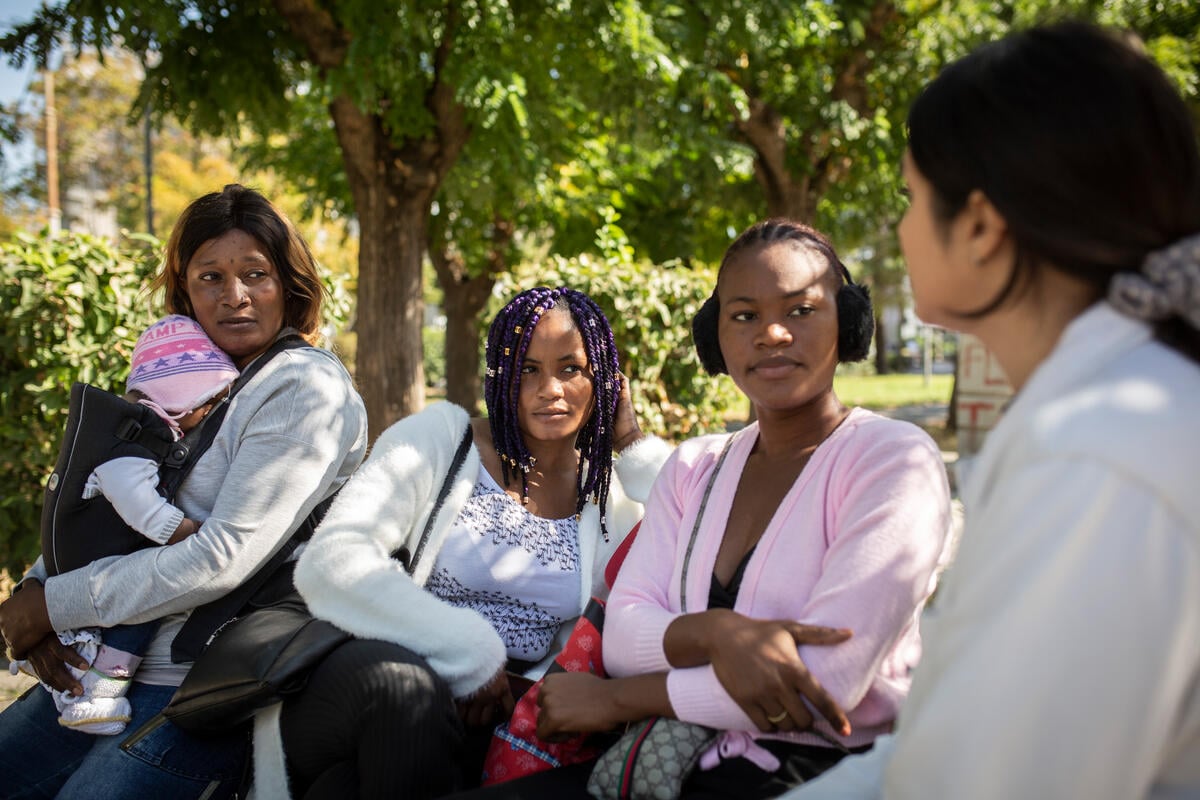
Greece. Shirin (R), originally from Iran, who works as Gender-Based Violence Prevention Officer at NGO Diotima Centre, together with Hawanatu, Memunatu and Fatmata, GBV survivors and beneficiaries of the GBV Prevention and Response Programme - a “shield” for refugee and asylum-seeker women on Lesvos.
Where can I find statistics and information about refugees and asylum-seekers arriving in Europe?
UNHCR maintains a public database of statistics on refugees and asylum-seekers in Europe and around the world. It has also developed a mobile application for iOS and Android. Each year, we publish a Global Trends report, an authoritative overview of the world’s refugees, asylum-seekers, internally displaced people and stateless persons.
In addition, data on specific situations in Europe can be found on dedicated operational portals (Ukraine, Mediterranean and South Eastern Europe).
Who are UNHCR’s partners in Europe?
As per its mandated responsibilities and in line with the Global Compact on Refugees, UNHCR engages with various stakeholders to pursue its protection and solutions priorities in Europe. These include governments, international organizations within and outside the UN system, other humanitarian and development actors, regional actors (notably the European Union and its agencies, the Council of Europe, the Organization for Security and Co-operation in Europe), local authorities, municipalities, academia, the private sector, media and civil society, including faith-based organizations. Refugees and other populations of concern are key partners, and we have been strengthening our engagement with refugee-led organizations. In collaboration with the European Council on Refugees and Exiles (ECRE) and the International Council of Voluntary Agencies (ICVA), we organize regular regional dialogues and consultations with civil society actors to identify opportunities for joint and complementary advocacy.
We are also committed to supporting the realization of the 2030 Sustainable Development Agenda and its Sustainable Development Goals. In Europe, UNHCR is an integral part of the regional UN system and co-chairs the Issue-Based Coalition on Large Movements of People, Displacement and Resilience.
In Europe, four of our offices are accredited to regional institutions (the Council of Europe, the Organization for Security and Co-operation in Europe, the European Union Agency for Asylum, and Frontex).
How do I locate a spokesperson who can tell me more about UNHCR’s work in Europe or the world?
UNHCR spokespeople at our headquarters in Geneva or in many of our country offices worldwide can be contacted to answer media enquiries and provide interviews.
If I am an asylum-seeker or refugee in Europe and need help or advice, what should I do?
You can use the help.unhcr.org page in some countries, or contact UNHCR or one of its partners directly in the country where you are.
If I want to work for UNHCR, what should I do?
You can find available job openings, internships and other opportunities on the careers page on UNHCR’s website and on the organization’s country-specific and regional websites. There are also opportunities to volunteer with UNHCR and its partner organizations.
How can I contribute to and support UNHCR’s work?
UNHCR relies almost entirely on voluntary contributions from governments, UN and pooled funding mechanisms, intergovernmental institutions and the private sector, as well as individual donations. We encourage these funds to be allocated as flexibly as possible to enable us to assist where the needs are the most acute by providing protection, shelter, water, health, education and other essential support to refugees, asylum-seekers, stateless persons and internally displaced people across the region.
UNHCR’s website contains information on how to contribute financially. Donations can also be made to individual refugee-hosting countries through our private sector partnerships and also to specific emergencies.
Stay informed with the latest reports and updates on UNHCR’s work in Europe
Find key figures and trends on displacement in the region and media highlights of the month.
Find refugee situation overviews and key priorities per country.
Find the latest data and statistics on refugees and other displaced persons.
Stay up to date on emergencies and our work in Europe.